
Introducing the Miyako Straight
Another int'l flashpoint soon to be a household name

I’ve been writing for several years about rising international system pressure leading to sparks at global chokepoints and territorial disputes. Most people are familiar with the more famous flashpoints like Straight of Hormuz, Malacca Straight, Suez Canal, the Bosphorus, etc. However, few have likely heard of, or looked into the significance of the Miyako Straight.
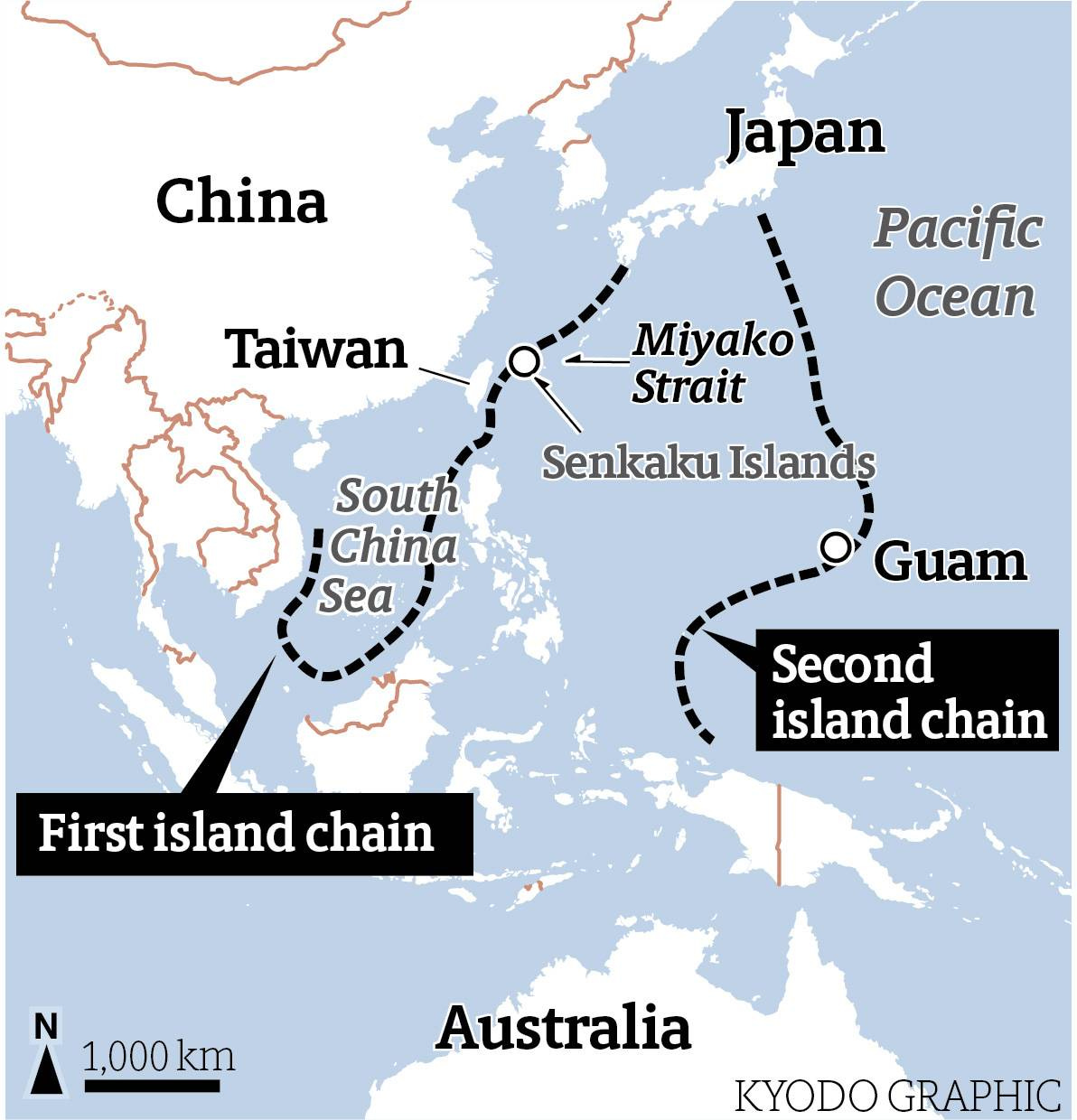
This crucial passage of the high seas hasn’t really featured as a flashpoint since 1945, when the last phase of WWII in the Pacific included fire bombing Tokyo and invading Okinawa. Once Okinawa was taken, all of the Ryukyu Islands (as they were called then) were claimed as US administrated territory. This included Miyako Island (and effective control of the Straight) and the southern most island; Yonaguni, just 110 km from Taiwan, and currently at the eye of the story in the China-Japan conflict.
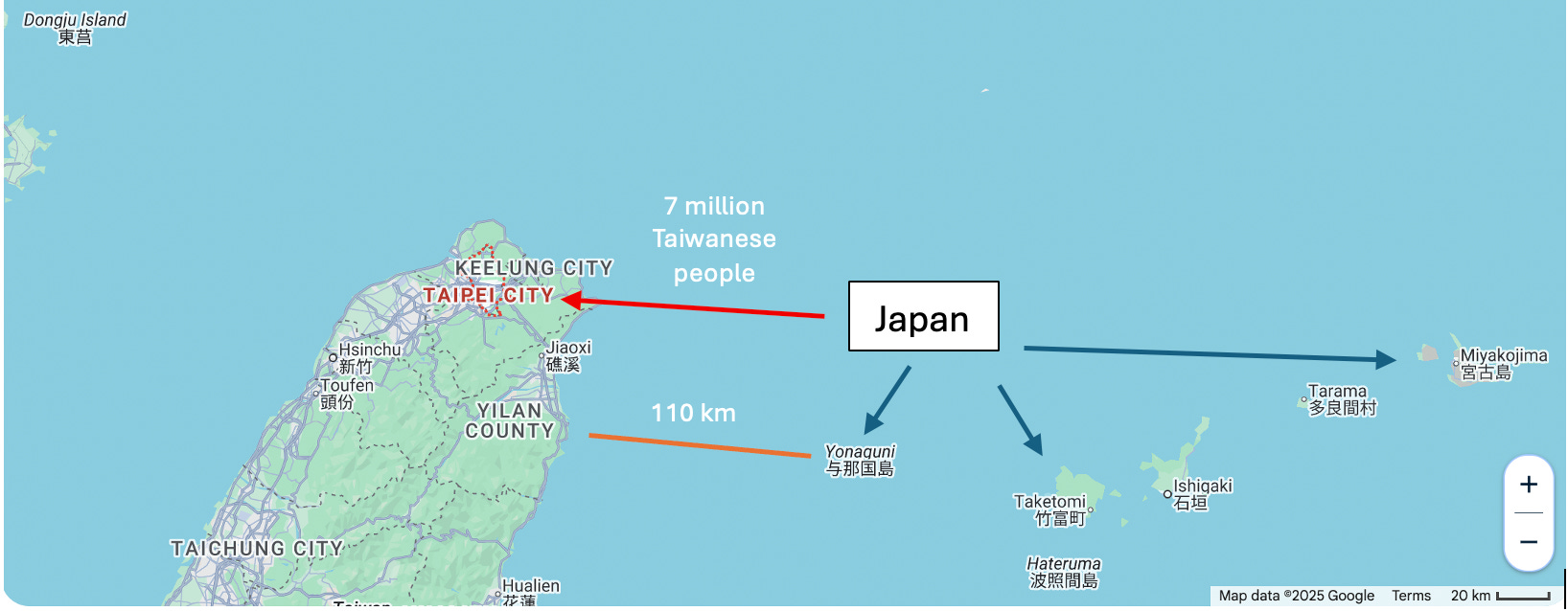
The Americans separated the Ryukyu islands into three administrative/military subgroups: Okinawa Islands, Miyako Islands, and Yaeyama Islands, which includes Yonaguni. American Ryukyu Island administration remained in place until 1972 when they were returned to Japan under the Okinawa Reversion Agreement. Thereafter, they again became part of Okinawa Prefecture, as they were pre-war. The islands were forced to change their governance structure back in line with Japan’s other 46 prefectures, driving was switched from American-style right lane back to the left side, and US$ was replaced with Yen.
This history would normally be of no more interest than other parts of the post-war exchanges between US & Japan, except for the now real possibility that China may implement a naval blockade as part of a military plan to retake Taiwan. This potential eventuality, framed in an opposition question directed toward newly elected PM Takaichi during Diet Q&A last month, has placed little Yonaguni Island (and the rest of the Yaeyama Islands) at the centre of the debate.
Japan began re-enforcing military installations in Yonaguni & Ishigaki following the Senkaku Islands Boat Collision Incident in 2010 that led to rising tensions with China. Japan’s nationalisation of three Senkaku Islands in 2012 was further taken as a change in status quo by China that resulted in various forms of retaliation (included the first restrictions on exporting critical minerals to Japan).
More significant investment in Yonaguni happened in 2016 with installation of surveillance & radar for electronic warfare, and start of deployment of Type 03 Chū-SAMs. In 2022, Ishigaki (300km from Taiwan) receives an upgrade with 510 GSDF personnel deployed, and its own set of Type 12 SAMs. Camp Ishigaki then hosted joint US exercises in 2025 (Resolute Dragon).
A war of words
The rapid escalation in this China-Japan war of words has been driven by extreme interpretation of PM Takaichi’s comments. The initial question directed to Takaichi by CDPJ opposition leader Yoshihiko Noda was,
“In the event of a Taiwan contingency, would the Self-Defense Forces engage in combat operations on Taiwan’s soil, or would Japan’s involvement be limited to defending its own territory under Article 5 of the U.S.-Japan Security Treaty?”
This was a follow-up to Noda’s earlier remarks criticising the government’s vagueness on “grey zone” scenarios, referencing the 2022 National Defence Strategy and recent PLA drills near the Senkaku Islands.
Takaichi’s reply escalated tensions, as she affirmed that Japan would “cooperate fully with the United States” in a Taiwan scenario, stating:
“A Taiwan contingency would directly threaten Japan’s survival and poses a grave risk to our national sovereignty. The Self-Defense Forces would take all necessary measures, including offensive actions if required, to ensure the security of the Nansei Islands and the first island chain.”
Nansei Islands are the formal, geographical term for the entire island chain, including the Satsunan Islands (north) and the Ryukyu Islands proper (south).
In a response to a query on whether rising PLA activity near the Nansei Islands (including Yaeyama) warranted expanded JSDF missile deployments, Takaichi tied it to the U.S.-Japan alliance, emphasising “comprehensive judgment based on intelligence” for actions.
“A Taiwan contingency—such as the deployment of military vessels or the use of force from the Chinese mainland—could constitute a ‘survival-threatening situation’ for Japan under the Legislation for Peace and Security of 2015. In such a case, we would exercise our right to collective self-defense to protect our national sovereignty and the lives of our people.”
“My remarks align with the government’s longstanding position. We will take all necessary measures, including defensive and responsive actions, to ensure the security of the southwestern islands in any existential threat scenario. Specific operational details cannot be discussed here, but our strategy prioritises deterrence and rapid response.”
The citing of the 2015 Peace and Security pact is what ignited the wolf warriors of China, as the legal framework allows for strikes on enemy forces, if they threaten Japan’s survival. Their assumption was that this statement justified attacks on PLAN positions anywhere, including Fujian Province, the natural PLAN staging area for a blockade. The term “responsive actions” was taken to mean pre-emptive, . . . against staging areas, by the hawkish critics, rather than “responsive” to the nature of the risks, as it was delivered by Takaichi.
In any case, and ignoring China’s obvious overreaction for now, the incident has brought full attention to this unique part of the Pacific again. Analysts and critics counted the days it took for a US response to be articulated, seeking to glean a level of US commitment implied by its response to the mini crisis of words. The US mainly matched supportive comments from State Dept officials at each step of the escalation, until last week when Chinese J-15 fighter jets attached to China’s CNS Liaoning aircraft carrier intermittently locked fire-control radar on JASDF F-15 fighters that had scrambled in response to such a close proximity naval exercise.
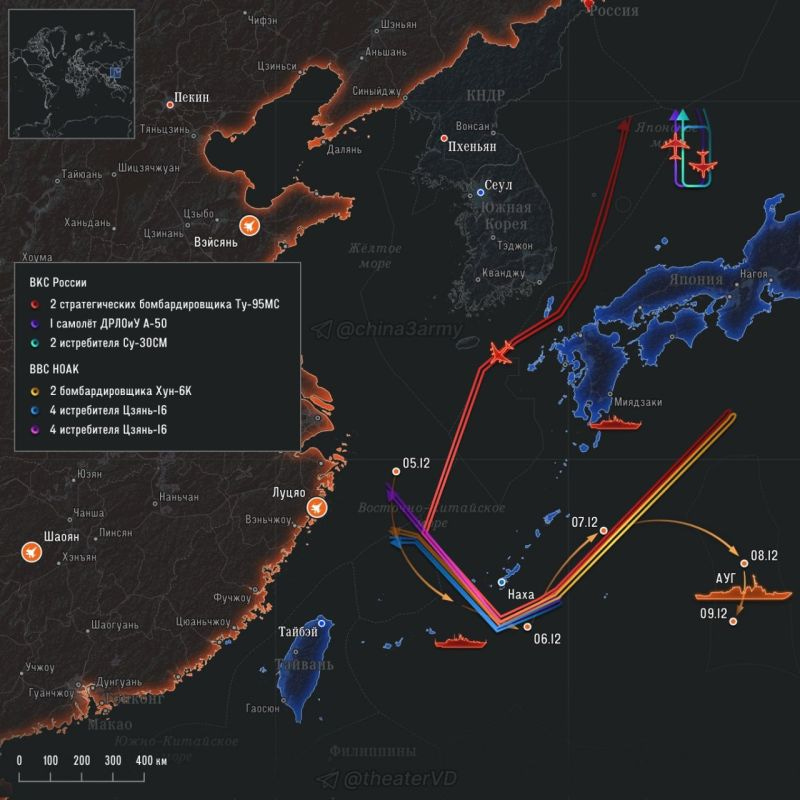
This level of escalation went beyond cancelling seafood imports and tourist flights, or threatening to chop off someone’s head. The subsequent circus of coordinated Russia-Chinese military exercises through the Japan Sea, the Miyako Straight and off the coast of Shikoku were too much. The US & Japan conducted their own high profile show of force Wednesday, flying B-52 Bombers, F-35s and F-15s and highlighting US -JSDF alliance strength (JSDF). [Below is the path of the Russian aircraft, passing through the Miyako Straight and joining China’s carrier group.]
My international waters
Now that the initial chest thumping is over, the focus will shift back to military investment and deployment on this crucial strip of the First Island Chain. The recently released US NSS 25 emphasised a desire for ‘overmatch’ as a deterrence strategy, of which a major component was expected to be allied investment in First Island Chain capabilities. Japan looks set to make good on that straight away. In addition to increased MIL budget allocations for Okinawa and the islands south of the Miyako Straight, it is very possible Japan will finally take measures to end anomalous exceptions to its territorial waters.
Since 1977, Japan has adhered to a voluntary supplementary provision for freedom of navigation that reduced its territorial waters to 3nm, instead of the international standard of 12nm, for Five Designated Straights. This is a Cold War-era political gesture aimed at avoiding conflict with Russia & America, as innocent passage of submarines are not required to surface as they pass through these narrow straights. Miyako Straight doesn’t warrant the provision, as it is very wide. The Five Straights are:
Soya Straight (between Hokkaido & Sakhalin)
Tsugaru Straight (between Honshu & Hokkaido)
Tsushima Straight (East & West, Sea of Japan)
Osumi Strait (between Kyushu & Tanegashima)
The rationale for these supplementary provisions has long expired, in many cases. Removing them, however, requires Japan to defend its sovereign decision, and it would need to see a clear improved advantage before changing. While such changes are unilateral sovereign decisions under UNCLOS (Arts 7 & 8 ), it would require contentious domestic legal changes, and careful consideration of international backlash . . . meaning the Russian, Chinese & North Koreans. The US also benefits from the ability to quietly move its submarine fleet around the North and West Pacific, and perhaps the South Koreans will as well, when their Sub fleet grows. However, coordination with allies can easily address exceptions.
Of the Five Straights, the one most likely to see revision is Osumi Straight. This most recent incident with China’s Liaoning carrier group fighter jets, argues for this step as a powerful gesture, signalling Japan will no longer tolerate China’s unnecessary military exercises so close to its sphere of influence. While the main carrier group passed through the Miyako Straight to position for their military exercises, two ships from the carrier strike force passed through the Osumi Straight on 8 December, just two days after the laser-lock incident.
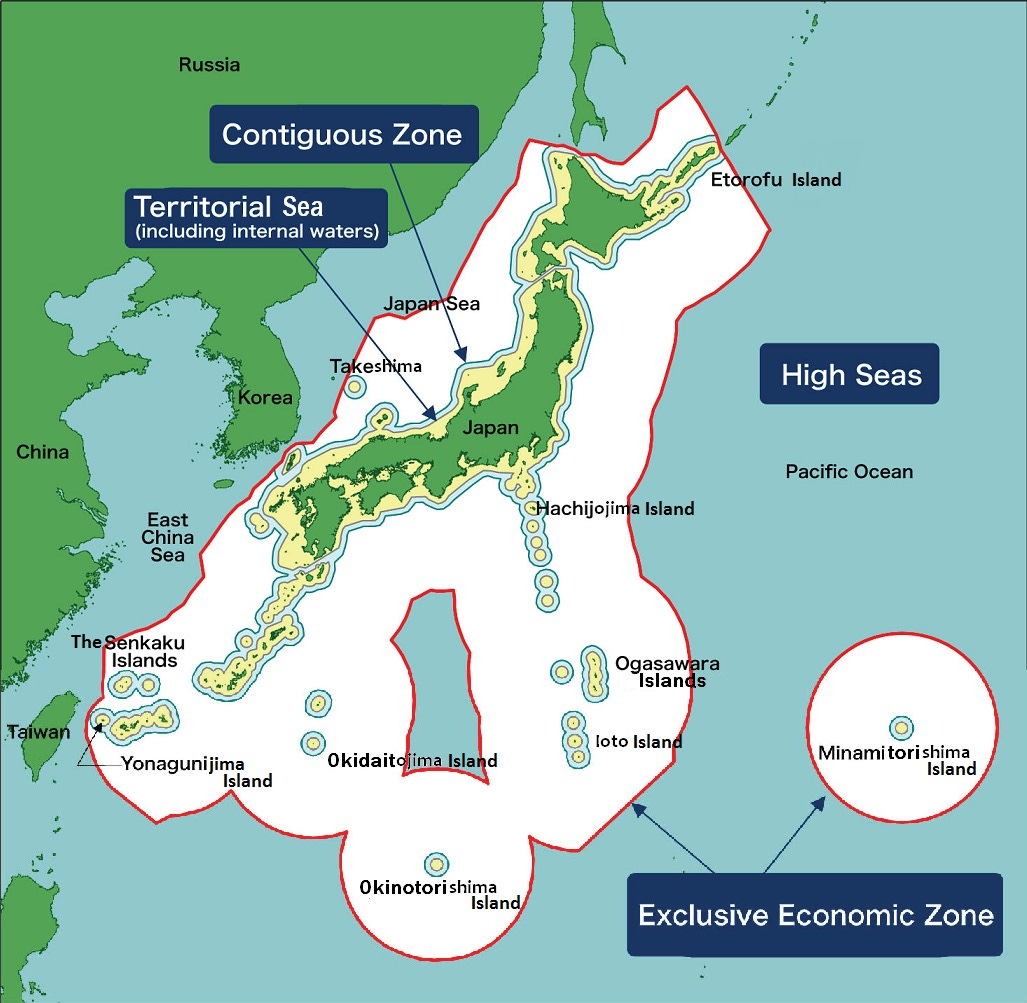
Expanding the Osumi Straight territorial waters to 12nm would effectively make the entire strait Japanese territorial sea and the legal regime would shift from high-seas to UNCLOS transit passage, allowing Japan to demand stricter compliance monitoring and reserve the right to regulate exercises. Subs would still retain submerged transit rights, but Japan would gain stronger legal basis to track, shadow, and potentially challenge “non-innocent” behaviour.
Going forward
The events of the past month have not pushed us closer to conflict surrounding Taiwan, but they have signalled an end to the period of free rein China has enjoyed surrounding the Miyako Straight and the Philippine Sea (West Pacific). Provocative military exercises with Russia surrounding Japan are no longer going happen without a response. This isn’t rising Japanese nationalism, but rather, the movement that began under PM Abe that revitalised national pride. Projecting leadership within the Free & Open Indo Pacific is now a national duty, as well as strong evidence of a strong ally.
The US for its part will be investing more resources in fortifying the Second Island Chain, while collaborating with allies on the First Island Chain to achieve ‘over match’ targets. For those that might imagine the US doesn’t understand the stakes or the territory, they should remember that Ryukyu Islands were US territory for 27 years, and they were the previous stewards of the Miyako Straight. The NSS 25 document highlighted the extensive focus on Taiwan and First Island Chain in general. Related bullet points from the NSS 25 were:
deterring a conflict over Taiwan, ideally by preserving military overmatch
United States does not support any unilateral change to the status quo in the Taiwan Strait
build a military capable of denying aggression anywhere in the First Island Chain
diplomatic efforts focus on pressing First Island Chain allies and partners to allow U.S. military greater access to ports and other facilities, spend more on their own defense, invest in capabilities aimed at deterring aggression.
This will interlink maritime security issues along the First Island Chain while reinforcing U.S. and allies’ capacity to deny any attempt to seize Taiwan
Strong measures, along with deterrence to keep SCS maritime lanes open, free of “tolls,” and not subject to arbitrary closure. Requires investment in military—especially naval—capabilities, strong cooperation with all nations, from India to Japan and beyond
increased burden-sharing from Japan and South Korea, defense spending, with focus on the capabilities necessary to deter adversaries and protect the First Island Chain.
strengthen military presence in the Western Pacific, determined rhetoric for Taiwan and Australia to increase defence spending
While doubts have risen over the past decade about the US’s commitment to Taiwan and its allies in the Pacific, a reading of the NSS 25 tells a different story. The shift in allied mentality toward collective defence in the Pacific has also steadily changed, both since the advent of an Indo Pacific Quad strategy promoted by PM Abe & Trump back in 2017, and the lessons drawn from the Russia-Ukraine war. Deterrence and readiness are now understood as one’s best defence. An aggressive military build up and power projection in the SCS by China has also produced a consensus faster than any moral suasion from the US.
The risks are now clearly known. It is up to each one of the Pacific countries to amend their historical postures to fortify the island chains. This signals both new investment and rising risk. Classic features of market opportunity.
Excellent brief!
Chain Gang :) https://open.substack.com/pub/themonentaryskeptic703/p/the-gulf-of-japan?r=1z5qli&utm_medium=ios