

Multiple regional security frameworks, multiple strategies
9 regional frameworks, Re-defining the First Island Chain, Coordination levels and 'trust at risk'

Regional security frameworks
The NSS 2025 flagged this tenant of the strategy in December, but a number of strategic changes were already making the new policy clear. The US has moved from a comprehensive global power projection posture to underwriting regional security frameworks that can assume ownership for regional peace, thereby reducing the US’s global resource burden.
This view was most prevalent in NATO debates, First Island Chain (FIC) investments, and decisive action in the Caribbean to eliminate risks from US enemies right on its border. What was probably not understood by many was that the Trump Administration is pushing for a similar regional security framework in the ME.
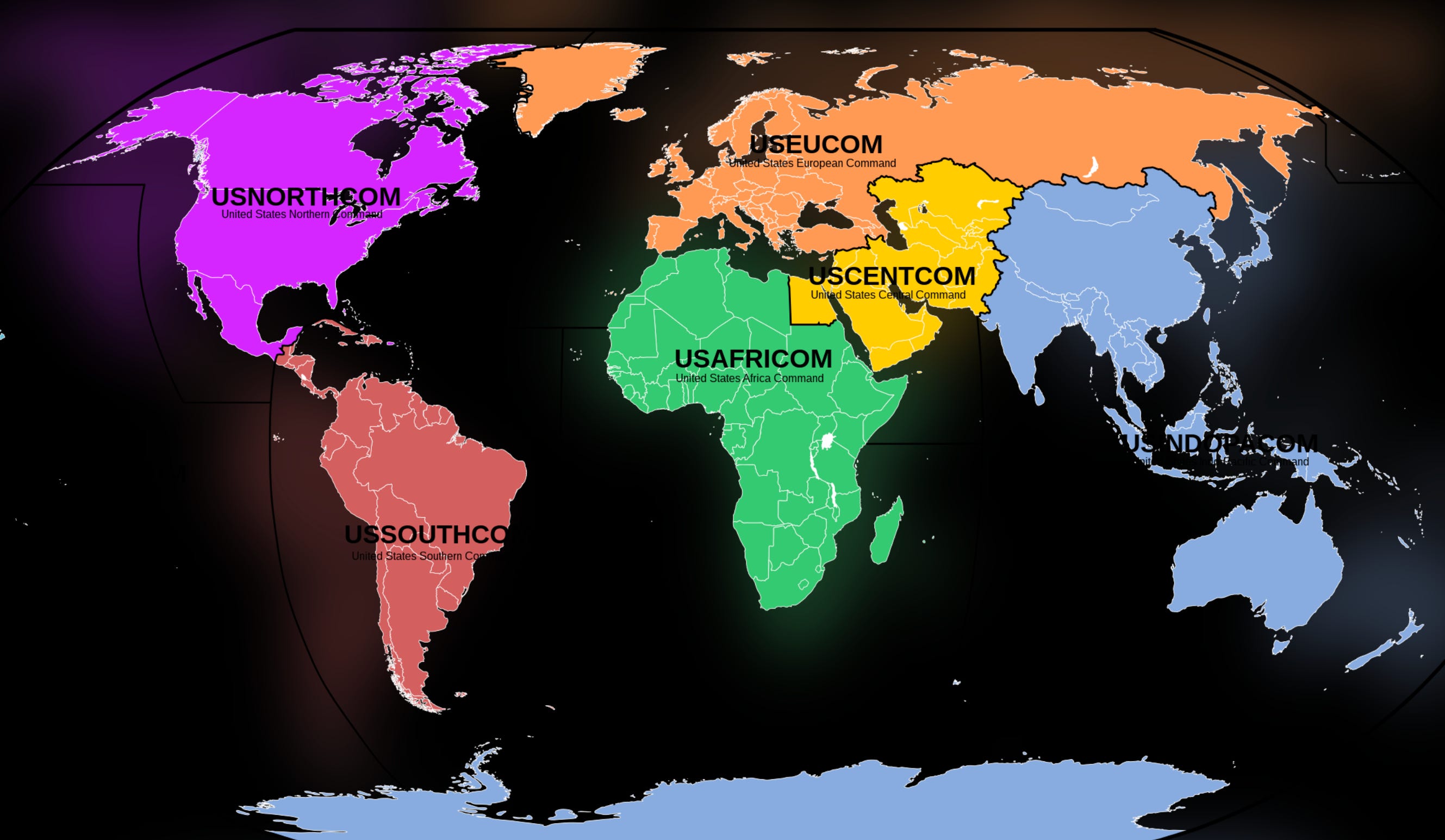
Both the Abraham Accords and Palestine’s Board of Peace were viewed as Trump pipe dreams, but behind these initial grandiose visions was a broader, more comprehensive overview of how the ME can restructure and do a better job of underwriting its own peace. I wrote about this early on at the start of the Persian Gulf conflict in March. The rationale way straight forward. The way Trump avoids another forever war is to hand the final stage of the process over to a regional security framework, once Iran has been offensively disarmed.
For many, they did not see Trump’s varied actions across these regional domains as consistent because the narrative of chaos was being constantly promoted by his detractors to undermine the strategy. The policy actions looked different in the ME because the trust at risk for each of these regional domains is different.
In Europe, the US has the highest level of trust at risk, with contingent defence liabilities through NATO Article 5. Therefore, a war of words, aggressively cajoling, and tests of operational redlines were used to effect necessary change in structure, without reclassifying the collective risks faced (risks unchanged, but slightly lower trust at risk deployed). This is the essence of the trust at risk definition (working paper).
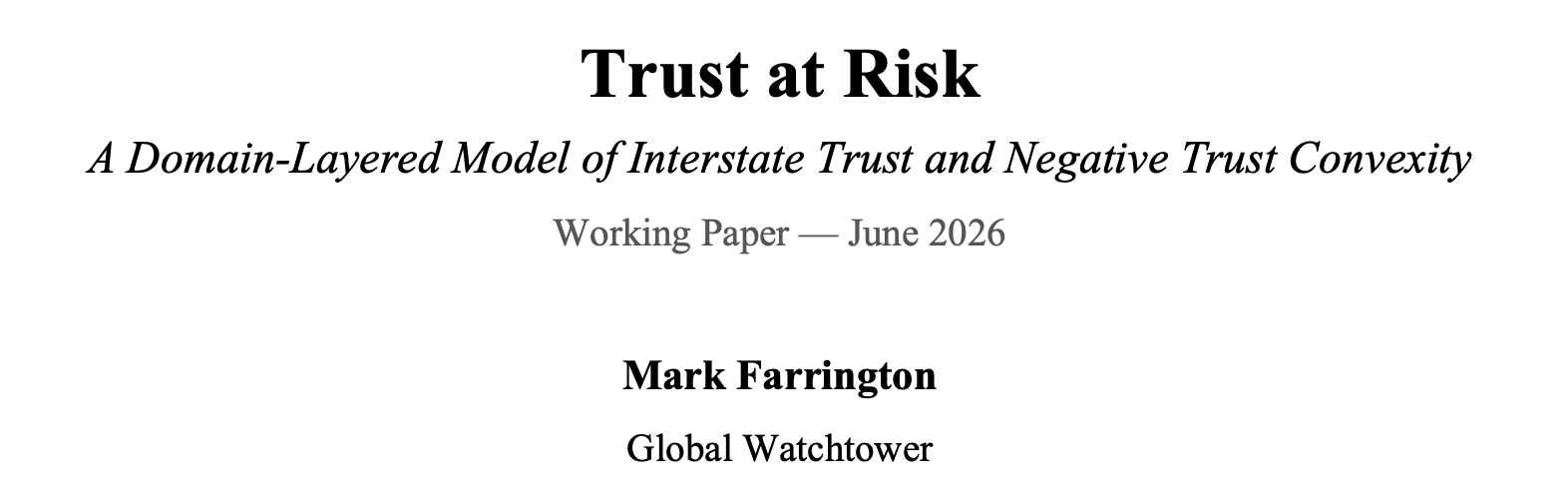
In the Pacific, redeploying strategic US assets to the Second Island Chain (SIC), while rewiring a new, more mobile strategy along the FIC, elevated Japan’s role to major (if not lead) regional coordinator. This will eventually extend to the rest of Indo Pacific, but enhanced FIC deployment was the urgent task. The US raised its trust at risk in a domain where negative trust convexity will be high. The US Pacific umbrella has been replaced with a stronger regional network topology (US, South Korea, Japan, Philippines, Australia).
The Caribbean was a house cleaning exercise first. The operational bases for American’s global rivals and antagonists had to be eliminated. These close proximity risks needed eliminating first. Then, as the NSS 25 highlighted, Latin American Champions were to be elevated. All of these initial efforts pushing toward a more unified Western Hemisphere protected under a Monroe Doctrine premise. The US was dialling up trust at risk in this regional domain where it had been allowed to fade tremendously over the past few decades.
The Iran ‘special military operation’ didn’t look to be obviously consistent in this context, but that is because too much of the world was focused only on the oil, and the shipping chokepoint. The real issue was a regional military imbalance that was preventing a nascent security framework from expanding. This is what had to be addressed; step one.
The GCC countries had been investing for a decade, wanting to change the region’s image to one of pro-business and stability. They were diversifying their economies away from oil toward service and entertainment sectors that required peace and stability in order to attract customers & investment. Iran was the spoiler. Iran’s aggressive military buildup, including offensive weapon capabilities that threatened the whole region, made it impossible to advance cooperation with them, . . . not while sworn enemies like the US and Israel were part of the vision.
While the Israeli military strategy toward Iran may have been to cut the head off the snake that represented its existential threat, the US wanted to eliminate Iran’s regional military supremacy. Not just the potential for nuclear weapons, which have their own risk/security logic, but excessive offensive military capabilities in general. An Iran reduced to parity with its neighbours (Egypt, Turkey, SA, Pakistan) was an Iran that could be brought to the negotiating table on regional security. A regional security plan that would keep the major powers out. Theoretically, a shared goal of Iran.
This fits the NSS 2025 by respecting over-extension, avoiding open-ended interventions, doing away with nation-building and extended deployments. The new core strategy of restraint. The ME remains a domain of global strategic interest, but current conditions do not allow the US to put much trust at risk in the region. In order to risk more trust, firstly, regional stability must be established. And firstly, that has to be delegated to those that live there.
Military rebalancing, followed by regional security frameworks, followed by fostering a pro-business environment that permits the US and other global investors to take additional leaps of faith. This was always the sequencing. Large investment capital allocations represent trust at risk as well. They require faith in stability. First things first.
Regional security architecture: US in, US out
In order to make sense of the US strategy in different geographic domains, one way to truncate the framework is to establish whether the US is to be at the core of the regional security architecture or on the periphery (intentionally). A crude legend might be something like this:
NATO - US in
Indo Pacific - US in
Western Hemisphere - US at the core
Middle East - US out
Mediterranean & Black Sea - US out
Baltic Sea - US out
Arctic & Northern Gaps (Atlantic & Pacific) - US at the core
Indian Ocean - US in
Antarctic & Southern Gaps (Atlantic & Pacific) - US out
These global geographic-driven domains each present a different risk profile and necessary resource allocation. Space can be added to this framework as well, via declinations like; near space, boundary, outer space, cislunar space, and deep space domain views. At the moment, the US is at the core for all except the near space domain, which invokes individual state sovereignty challenges.
The resource allocation the US will make in each of these domains, while operating under a scarce resource reality, will be driven by the degree that it is central to the configuration and the amount of trust at risk it has with regional partners. Strong partners with high trust lead to higher levels of delegation and cooperation. Low centrality to the regional domain leads to high delegation, but lower levels of cooperation; minimising trust at risk.
First Island Chain as an example
One of the best ways to understand US national security strategy in 2026 is to watch Japan’s moves. The FIC is a well known geo-strategic framing now and much of what the US does in the Pacific arena is now viewed through this FIC - SIC defensive framework.
Historically, the FIC was defined as seen below. The important first observation to note is that Taiwan doesn’t exactly line up geographically as FIC. The immediate deep water descent into the Philippine Sea and Pacific Ocean for much of China’s submarine fleet are the two deep-water channels to the north of Taiwan (Yonaguni Strait) and to the south (Bashi Channel). The Bashi Channel to the south, above the Batanes Islands of the Philippines, is the primary exit point for PLA nuclear submarines.
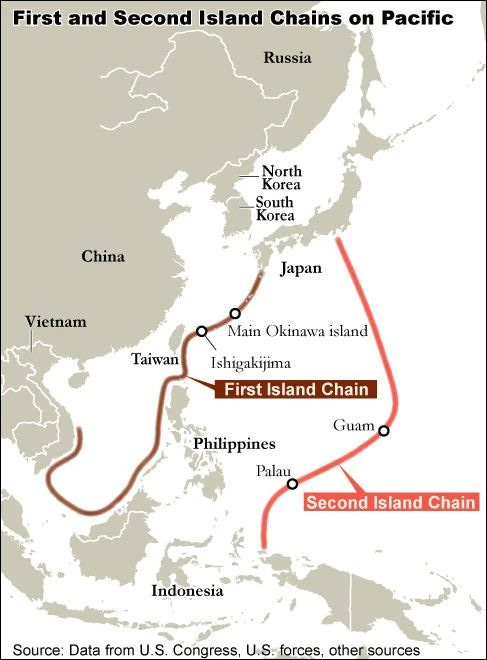
The implication being; Taiwan is not a connected defensive node within the FIC, it is a geographic impediment that drives chokepoint management. The FIC of allied defence structures are/will be built along the Japan-Philippine island chains. The battle for Taiwan, or naval battles in the Taiwan Straight are a totally different war theatre with different war logic.
In the Pacific theatre, the US has the most trust at risk allocated in Japan, and all its policy decisions continue to reflect this. Philippines saw a decline in trust at risk deployed by the US during the period of Duterte’s presidency (2016-22), which have systematically been rebuilt since Marcos Jr became president.
Importantly, Japan has taken a lead on many of these endeavours, strengthening the regional framework as foundational support for US trust allocation. Not simply depending on US-Philippine bilateral ties, or based on fluid personal relationships between Malacañang Palace and the White House. Japan is building regional structure. This allows the US to be “in” but not necessarily the core.
A regional structure is stronger with the US in it, with all its massive military capability, but that fact on its own does not necessarily make it more stable. Stability comes from the regional architecture being built, underwritten, and maintained by those living in the geographic domain. US interests are highly tied to the FIC chain, but it doesn’t live in the FIC. This is why Defence Minister Koizumi is the busiest diplomat up and down the Pacific, from Australia to Indonesia, to Vietnam and Philippines.
On nautical charts like this one below, you get a much better sense of distance in what would be a naval battle, should the US and China ever inadvertently collide. You can easily see that the real battle field will be the Philippine Sea, not the waters inside the FIC. This is why openly discussing Taiwan’s fate is counterproductive for both the US and Japan. It protrudes outside the FIC defensive perimeter into the PRC’s killzone. Its battle plan for self-preservation will depend heavily on domestic fortification and fortress denial on the western flank. The FIC battle lines are only helpful on the eastern side of the island, and targeting the chokepoint channels to the north & south.
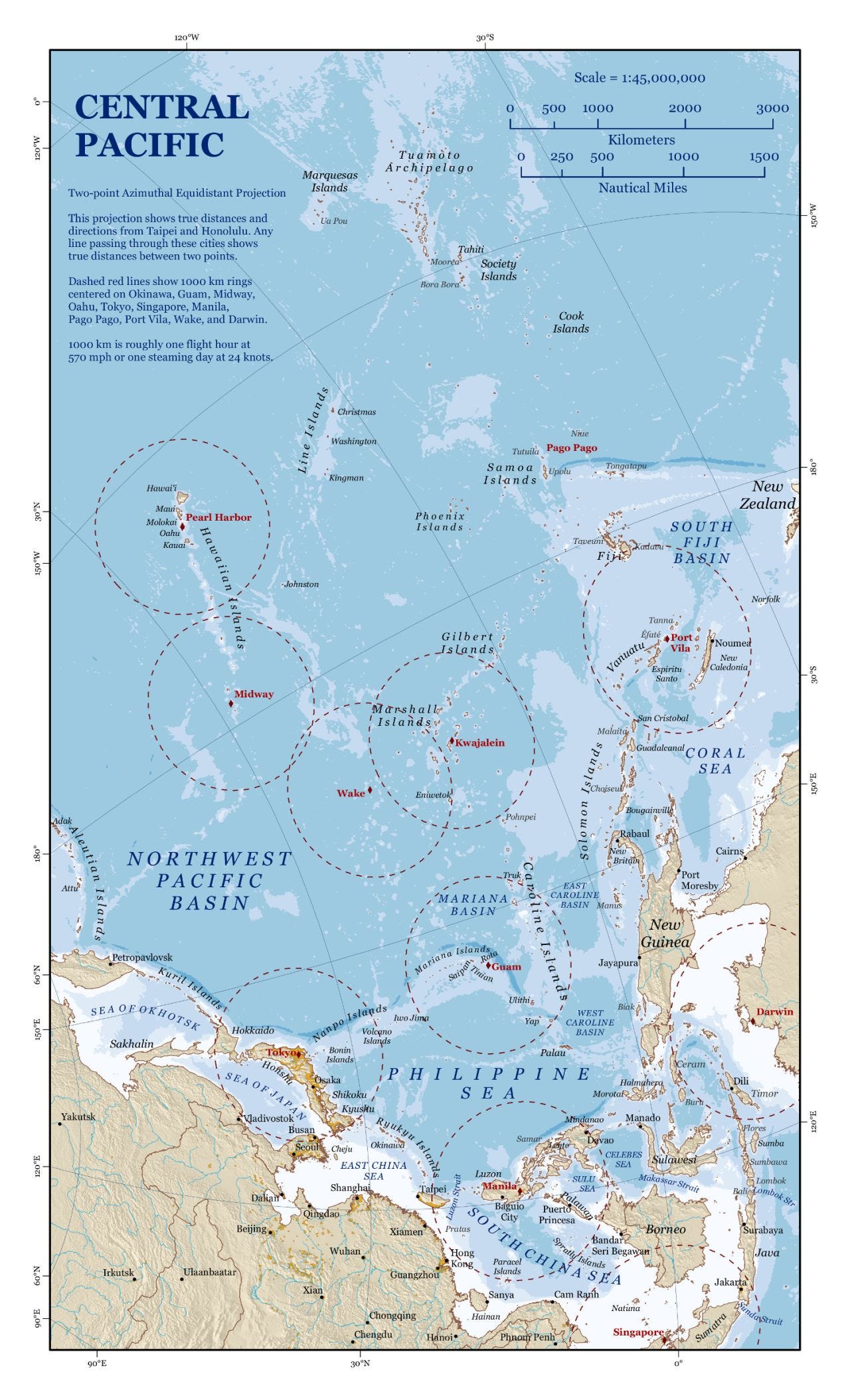
The US has relatively high levels of trust at risk already allocated to Taiwan, but they are primarily investment and capital based. Faced with severe negative trust convexity, should China ever invade Taiwan, the US has been hedging for the past decade. Taiwan’s elite have been hedging as well. The shift of TSMC’s global semi Fab strategy to Kumamoto Japan and Arizona in the US is the core part of this hedging strategy. Strengthening and building the FIC & SIC military defence lines is also hedging Because, even after taking Taiwan, China’s access to the deep ocean is still a relative narrow domain highly flanked by Japan, Philippine, and US deployments.
Reducing the US-Japan negative trust convexity in Taiwan to the point it is not a total global catastrophe, should China invade, would increase the probability of the event, and simultaneously increase the benefits of peaceful integration. Taiwan accepts its fate, negotiates a One China Two Systems deal that is better than the one Hong Kong got, and US-Japan-Philippines & China negotiate a regional stability framework for the Philippine Sea.
Hegemony vs giant in the room
While this interpretation of the new US security strategy may seem over-nuanced to many, and some may attribute it to back-fitting event outcomes, those that have read my posts for many years, or know me personally will know that I have been promoting this kind of change to US national security strategy since 2015.
I celebrated that Washington seemed to have finally woken up when Trump’s NSS 2017 was published, which finally addressed the issue of revisionist power (thanks to Nadia Schadlow). And, when Elbridge Colby wrote his now famous book Strategy of Denial in 2021, and then became Under Sec of Defense in 2025. This shift in national security strategy coincides with Trump’s arrival in the White House, it isn’t simply driven by him.
What underpins the new NSS 25 that aligns most with my views is the acceptance of reality. The acknowledgement that spin and political narratives are tools to be used, but they can’t replace hard facts and military realities on the ground. If deterrence isn’t real, it won’t work. You may fool the population through narrative warfare, but you won’t fool your enemies.
An adjacent point to this is honest attribution of what hegemonic power really is. So much of IR and NSS theorising is derived by simplistic attribution of hegemonic power, when many times, the primary hegemonic influence is just simply to be the largest one in the room. When it comes to existential battles, being largest in the room doesn’t dictate all behaviour, only some. Simplistic hegemonic calculations imagine a fight to the death, to the last 20% of resources, which of course would favour the hegemon. However, in reality, all sovereigns stop at some point far earlier than that.
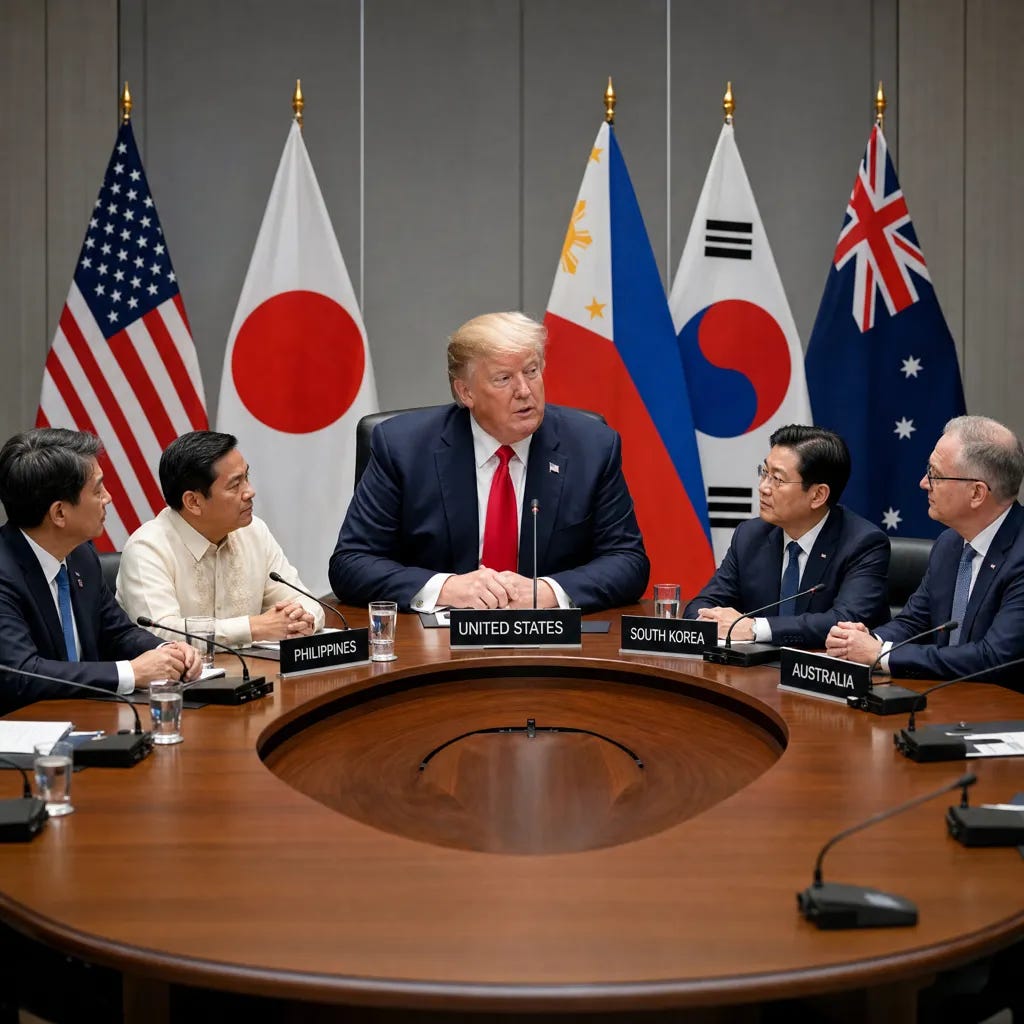
For the US to successfully project global power frugally, interlocking with various configurations of regional power structures, it must be able to analyse trade-offs as both ‘just another participant’ in the framework, as well as the giant in the room. The hegemonic factor should be only one iteration of the possible analytical tangents.
Thought in terms of capabilities brought to the table, adding to the collection of diverse capabilities that all the regional framework members bring to the table, . . . this allows the US to calibrate just how much trust at risk it wants to allocate to each regional framework. Because this truly is where the hegemonic calculation does come into play. The US will end up being part of more regional frameworks than any other country. That’s where size matters.
Within each regional framework the US needs to be analysed by its partners, and to be allowed to make its own net assessment of its involvement based on being just another member of the group. It may seem semantic, but it effects the framework for analysis. In any given regional framework, other members will invariably view all US capabilities as being on offer; accessible through their shared regional framework. But they won’t. The US will decide how much of, and what category of its capabilities it will offer to each regional frame work based on the negative trust convexity of each commitment.
I will conclude by just saying that these framework issues are extremely relevant for my way of processing the world, and to dimension possible policy responses. You can’t anticipate policy outcomes unless you thoroughly understand the systems framework and reaction function of the policy markers.
This exploring and stress-testing ideas on structural change is my way of trying to get ahead of the curve. If I am less surprised than others when complex events occur in a seemingly unpredictable way, then I conclude that I’m on the right path. My systems analysis might be right.
At the moment, it seems to be working reasonably well for anticipating US national security policy decisions. I’ll stick with it until facts & outcomes force me to change my mind.
Good hunting!