

Full-stack diplomacy
National security framework, America AI First, Cold War AI style

The national security view
The US has a lot of familiarity with the ‘full-stack’ concept. It has been managing highly sensitive military hardware projects with this in mind for decades. The F-35 examples are many and easily understood.
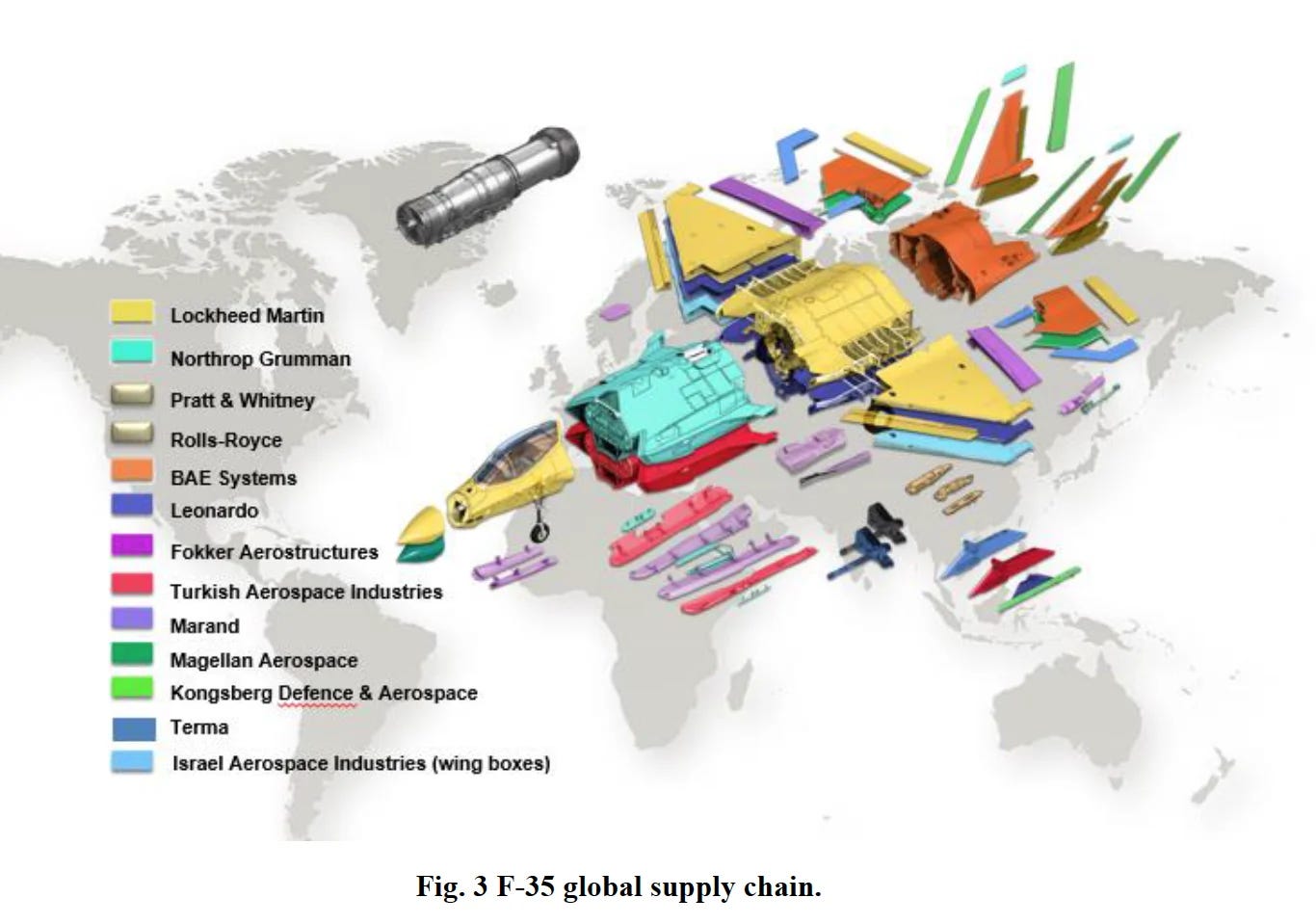
Historically, collaborating with allies and building a global supply chain team made the most sense, not only from a traditional comparative advantage perspective, but it provided essential training and industrial complex integration with US standards. This ensured both mechanical interoperability and personnel skill consistency. Essential during both times of peace and war.
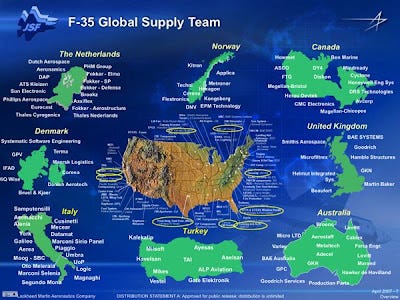
High-level military hardware is rarely dual-use. The export of US military hardware is very specifically controlled, as is the higher threshold of project, R&D, and development integration. These are relationships and decisions made at the highest level on the ‘trust at risk’ spectrum. Technology, more generally, enters the process more often from the dual-use channel and eventually finds its way into military finished goods, which may or may not trigger retroactive, stricter dual-use export controls.
These allied global supply relationships made sense within a military industrial complex framework. As technology speeds ahead in the domains of AI, automation, autonomous, and space-based, it flips the proprietary nature and potential deployment track of some of these causal chains.
The AI ‘full-stack’ concept is one that has driven significant changes in US national security, economic resilience, and dual-use strategy. It is geo-economics at its core, but with the highest level of national security risks embedded. The dual-use conundrum has never been more complex.
However, sticking with the purely geo-economic perspective, the American AI Export Plan aims to ensure full benefits of the AI dominance story accrue to the domestic economy. Whether it is on national security grounds, economic resilience, or high-skilled job growth, the strategy justifications all point in the same direction; extensive home bias.
America AI First
The game has definitely changed since the 90s. Succeeding now requires securing where the gains accrue. China’s full-stack is similar; 100% Chinese companies.
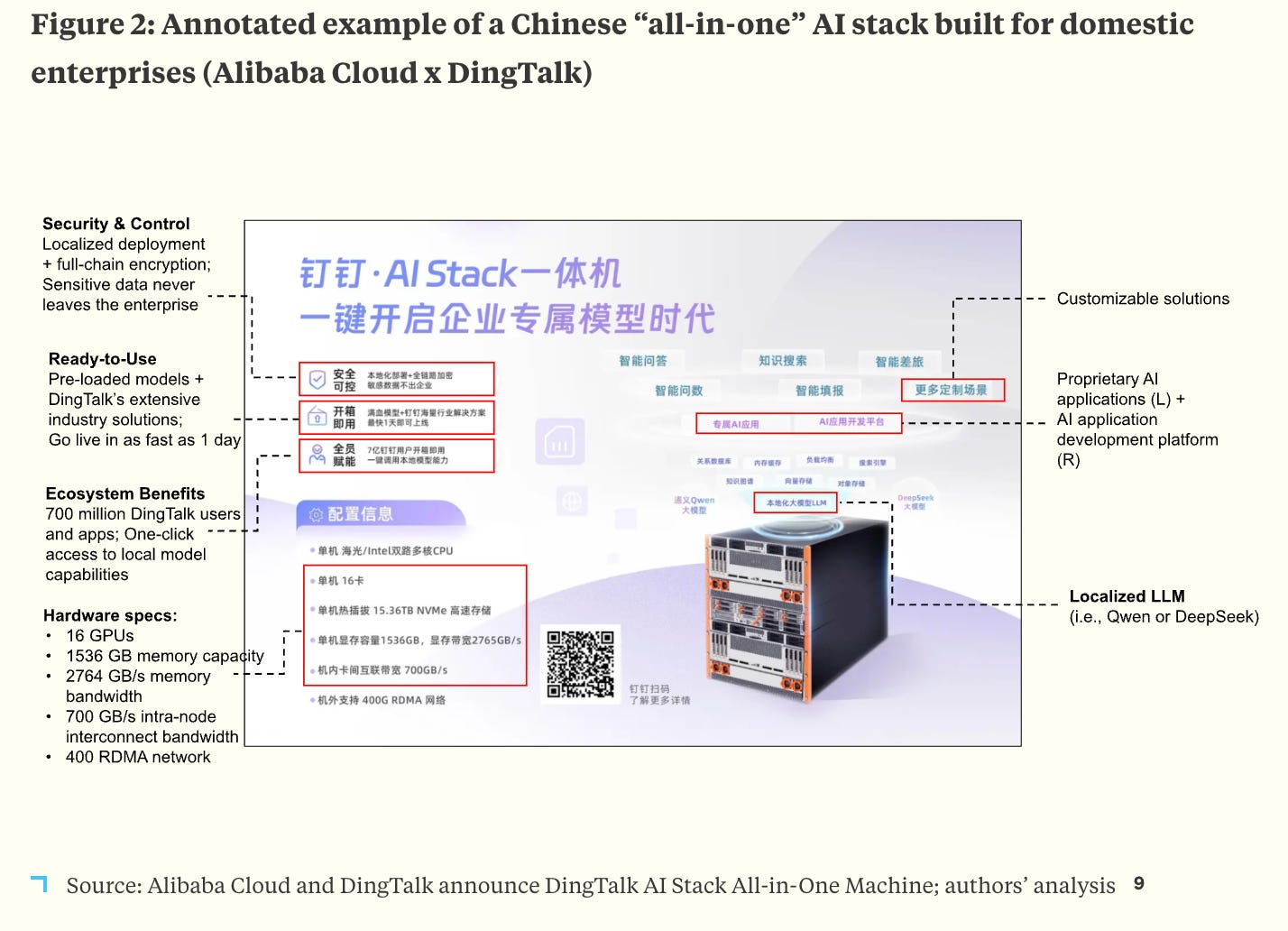
Perhaps it is true that only the superpowers will pursue this closed-loop, vertically integrated domestic model. France, for example, is pushing a so-called "Sovereign-Open" Hybrid Stack approach, while India is developing a so-called Comparative Advantage Supply Consortium model. Both seek to lock in what domestic advantage they have, while pragmatically completing the stack through partnership.
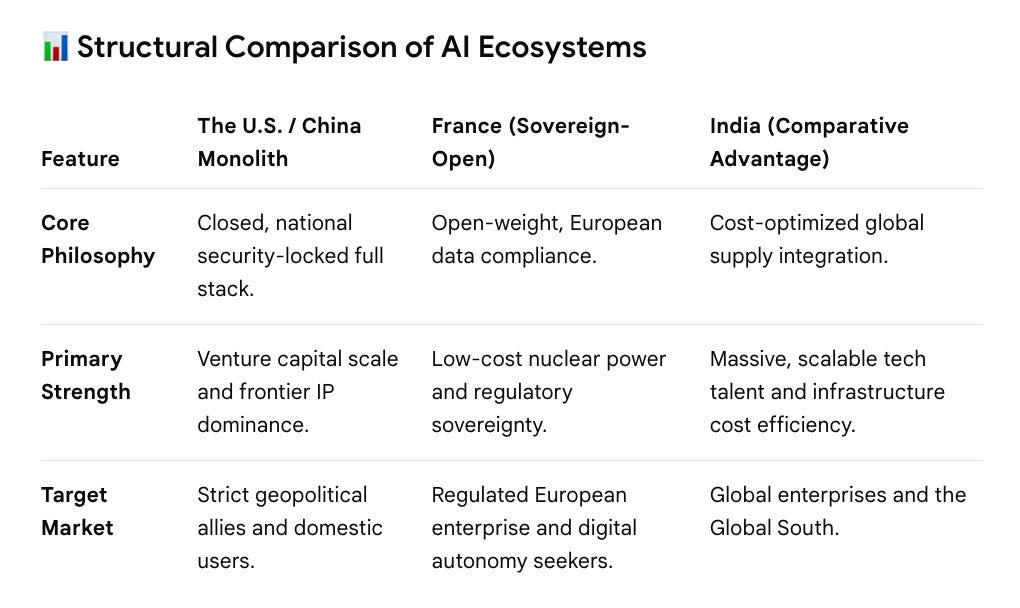
Always curious to see how AI slices the analysis, I asked Gemini to compare them to historical smartphone strategy models. Amazing how it reflects the typical limitations and inclinations of their existing national champions and theoretical comparative advantages. The world view is embedded.
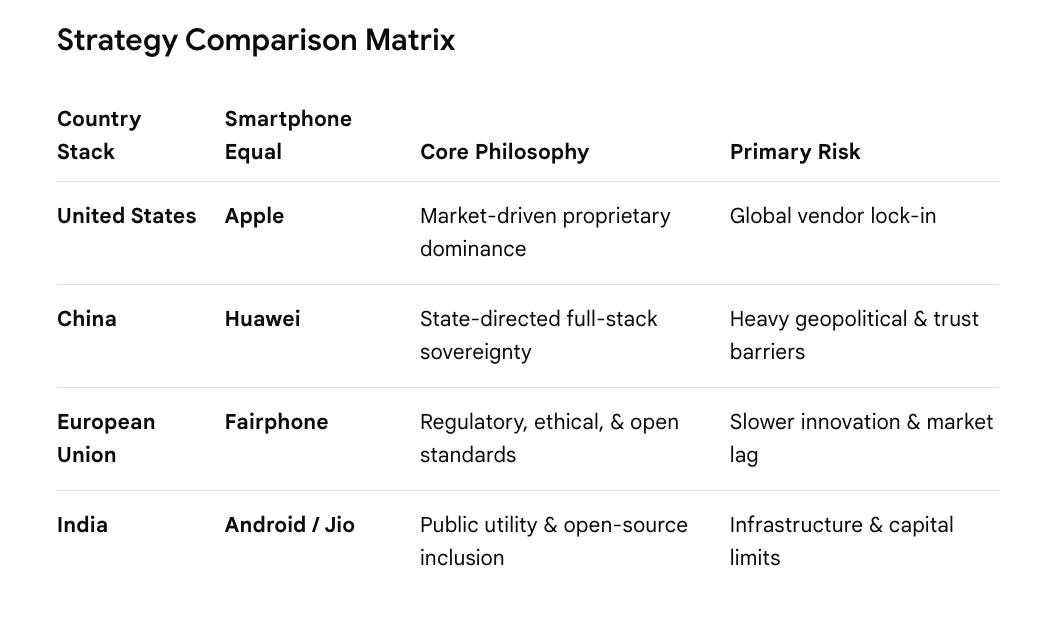
While fascinating to watch this technology inflection point race start again, my primary interest is to determine to what degree the US has got the geoeconomics right this time. Essentially, the Trump Admin wants to build an AI-Apple America First champion. Meaning, it wants to ensure to lock in the jobs and tax revenues inside US jurisdiction this time. During the hyper-globalisation phase, business models were allowed to evolve within only one needle in the compass; most efficient profitability. The national security bifurcated world of the mid 21st century now requires a more curated outcome.

US industrial policy now targets these outcomes pre-emptively. The American AI Strategy promotes specific incentives like qualifying for expedited federal permitting, financing, and export licensing, along with compliance requirements like core components of the stack maintained locally, in a U.S.-registered corporate structure. It further targets foreign nations from draining taxable revenue from American AI companies via digital taxes by threatening tariff retaliation.
As we are mid flight in this race, most of the companies are accepting the guardrails and offers of assistance. But there will come a time when the market place is better defined and offshore clients more discerning. Will the US hub & spoke market look similar to its global security partnerships? Will China’s client base be primarily its Belt & Road satellite states? Will France use its energy dominance and its current lead position to dominate compliance fortress Europe? Will India deploy its massive entrepreneurial tech workforce to build the most end-user products on open source models?
The first stage seems much more predictable. The US will provide incentives and favourable terms to its ‘core trusted fortress’ (Europe, North Asia & Australia, Americas). China and India will compete for the Global South, while the high-growth ME and SE Asia will be the contested middle ground.
This is where ‘approved’ derivatives of the American AI Strategy will likely be important. Japan can be empowered to offer complimentary services to a US-skeptical SE Asia, while France can offer complimentary services to a US-skeptical MENA. The global carve up will look very familiar. Trust at risk drives everything.
Cold War AI style
The geopolitical AI strategies viewed from this angle tell a story about the next iteration of globalisation within a bifurcated world. The lines of global cooperation and partnership don’t look set to change that much. The AI rivalry will mirror the current military and economic rivalry.
In the end, the primary battle between US and China will determine most things, but there will be alternative model challenges. Call them middle powers, or call them non-aligned, there will be efforts to resist, to slow, or to sabotage rapid world dominance by one of the superpowers.
In terms of an investment strategy to drop out of this review of the new competitive landscape, I see the US holding (and building!) a very strong hand. There is a style vs substance problem with Trump as president and America First as a rallying cry, but geo-strategically, the countries that are clear-eyed about the challenge China presents are inclined to validate the US moves taken so far. And Trump’s replacement in 2 years may offer the style change many hope for.
Like nuclear weapons, if the US proves to be the most trusted steward of AI and AGI, then more countries will coalesce around the US strategy. In the end, the USSR proved to be an admirable custodian of nuclear weapons during the Cold War, but along the way, opacity fostered continual fear amongst the world’s population. The CCP has a similar effect now. The world doesn’t trust them.
And, given that AI offers profound surveillance and subjugation powers over the general populations of the world, lack of transparency and accountability will drive antagonism even more quickly than the somewhat unfathomable threat of mutually assured destruction.
Greater transparency and respect shown to the people helped win the last Cold War, it will be the same again.